Overview
The Harp Sound Card and Audio Amplifier are open-source, high-fidelity audio devices specifically designed for behavioral research experiments.
Consumer-grade audio systems are designed to operate within the human auditory domain, are not optimized for real-time audio applications, and rarely support synchronization or precise triggering of auditory stimuli.
The Sound Card provides:
- Wideband frequency support up to 80 kHz for experiments involving ultrasonic communication.
- Low-latency sound playback via onboard waveform storage and digital input triggering for closed-loop experiments.
- Convenient generation of auditory stimuli, with the Sound Card app to create and upload waveforms and an onboard sine wave generator for pure tones.
- Hardware timestamping and synchronization with other Harp devices for seamless alignment of experimental data.
- Bonsai integration for flexible experiment acquisition and control.
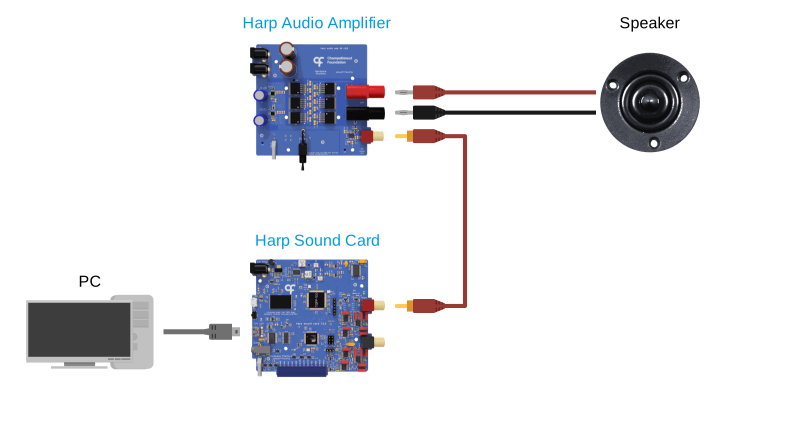
The Sound Card requires an amplifier to drive speakers for sound playback, and the Audio Amplifier has been designed to pair with it for low-distortion amplification. A full end-to-end audio characterization of these two devices with a connected speaker has been documented in this publication.
Getting a device
Assembled units are available from the Open Ephys store, or build your own using the hardware design files in the Sound Card or Audio Amplifier repository. Once you have a device, follow the "Getting started" section to set up the device and install the software.
Acknowledgments
Hardware design and Sound Card app contributed by Champalimaud Foundation, Bonsai interface by NeuroGEARS, testing and feedback by Allen Institute for Neural Dynamics, and documentation by Open Ephys.
Documentation for release v3.0.0